
Search for an accountant online and you will find quotes as low as £99 for a tax return. For a small business owner watching every pound, that price is tempting.
The trouble is that accountancy is one of the few purchases where the cheapest option can end up costing you the most. A rushed return, a missed expense or a late filing does not show up on the invoice. It shows up months later, as a tax bill that is higher than it should be, a penalty letter from HMRC, or a set of accounts that someone else has to rebuild.
This article explains where cheap accountants tend to go wrong, what that costs in real numbers, the warning signs to look out for, and how Penny Minders does things differently.
Where cheap accountants go wrong
In the UK, anyone can call themselves an accountant. There is no legal requirement to hold a qualification, carry insurance or belong to a professional body. Titles such as "chartered accountant" are protected, but plain "accountant" is not.
That leaves room for operators who compete on price alone. To make a £99 return pay, they have to spend very little time on it. In practice, that usually means:
- No questions asked. Your figures go straight onto the return without anyone checking what is missing or what looks wrong.
- Expenses left on the table. Use of home, mileage, phone, equipment and professional fees all reduce your tax bill, but only if someone asks you about them.
- Deadlines missed. High-volume, low-fee firms take on more clients than they can handle, and January is when it shows.
- Mistakes passed to you. If HMRC opens an enquiry, the return has your name on it. You pay the extra tax, the penalty and the interest, not the accountant.
A worked example
Take Sarah, a self-employed graphic designer with £45,000 of profit. She picks a £300 online accountant over a qualified firm quoting £850.
Her cheap accountant never asks about her home office or the miles she drives to clients. Those come to £3,000 of allowable expenses that never reach the return. At 20% income tax plus 6% Class 4 National Insurance, Sarah overpays £780.
The return is also filed a few days after 31 January, which triggers HMRC's automatic £100 late filing penalty. The next year, Sarah pays a new accountant £600 to unpick the mess and amend the return.
Sarah's £300 accountant has now cost her £1,780. The chart below shows how it adds up.
What the cheap option really costs
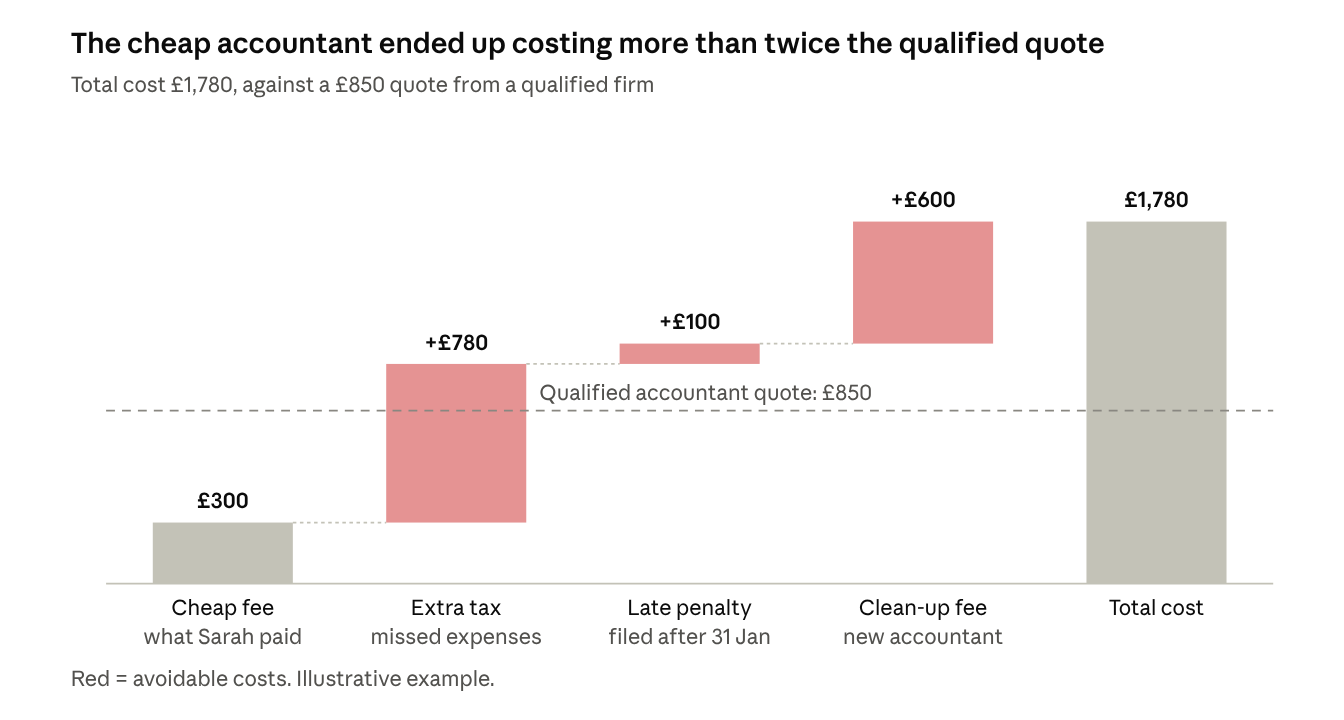
Illustrative example. Tax at 20% income tax plus 6% Class 4 NI on £3,000 of missed expenses.
The saving Sarah thought she was making disappeared in the first year. The extra tax alone was almost the full difference between the two quotes.
Late filing is where small savings turn into large bills fastest. HMRC's penalties do not depend on how much tax you owe, and they keep growing the longer a return stays late.
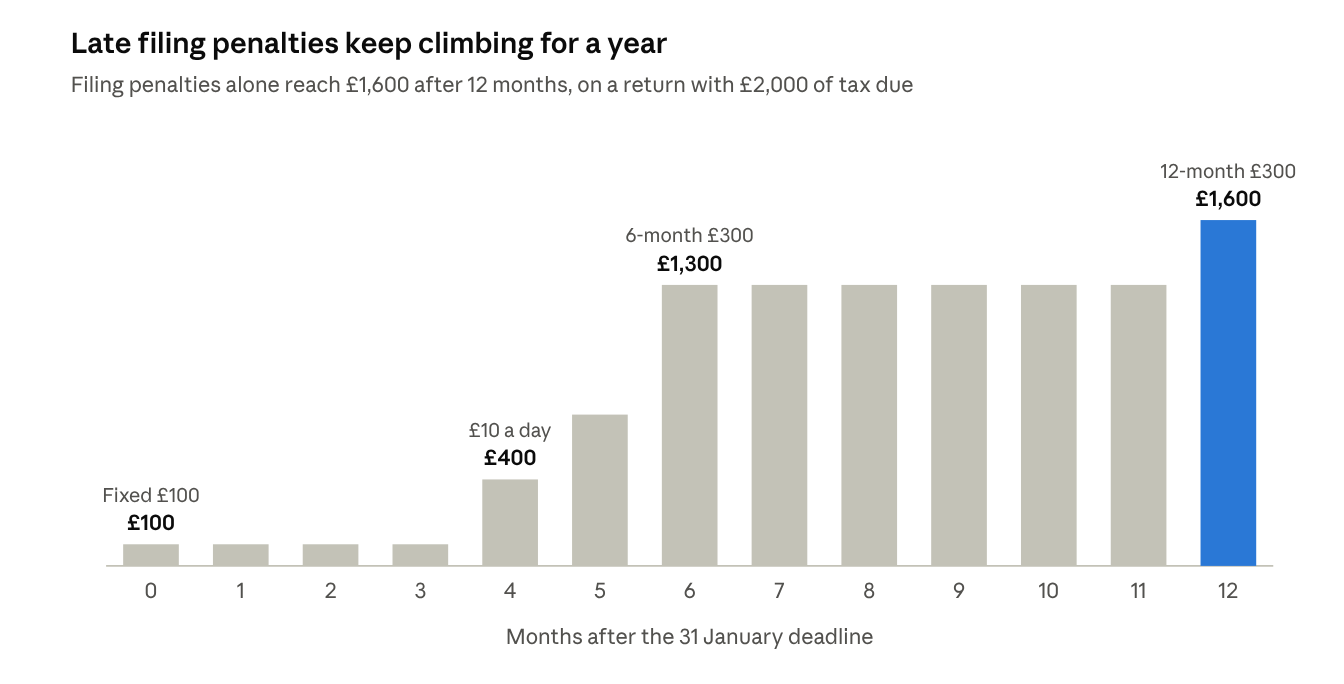
Source: GOV.UK Self Assessment penalties. Filing penalties only; late payment penalties and interest come on top.
A £100 penalty sounds manageable. A year later, the same missed deadline can cost £1,600, before late payment penalties and interest are added.
Five warning signs to watch for
A low price on its own is not the problem. The problem is what a low price usually leaves out. Before you hand over your books, check for these red flags:
- No qualification or professional body. Ask which body regulates them, such as the ICAEW, ICAS or ACCA. A qualified accountant will tell you straight away. A vague answer is your answer.
- No professional indemnity insurance. If they make a mistake that costs you money, insurance is how you get it back. Without it, you carry the loss.
- No questions about your business. A good accountant wants to know how you work, where you work from and what you spend money on. A form to fill in and nothing else means nobody is looking for savings.
- A price that never changes. A sole trader with ten invoices and a landlord with six properties do not need the same amount of work. One flat fee for everyone usually means the work is cut to fit the price.
- Silence until January. If you only hear from them in the last week before the deadline, expect a rushed return and very little advice.
If two or more of these sound familiar, it is worth getting a second opinion on your last return. Mistakes can often be corrected through an amendment, but the window to do so is limited.
How Penny Minders is different
Penny Minders was set up for small business owners who want their accounts done properly, at a fair price, by people who know what they are doing.
Our accountants are qualified professionals with many years' experience in both practice and industry. Between them they have worked in audit, advisory and senior finance roles for large organisations, and they keep their knowledge current with ongoing training so your return reflects the rules as they stand today. That is the same standard of work large organisations rely on, applied to your business.
Here is what that means for you.
We ask the questions. Before we file anything, we go through how your business runs, so every allowable expense is claimed. In Sarah's case, that conversation alone would have saved her £780.
We work to deadlines, not to the last minute. We track your Self Assessment, Corporation Tax and Companies House dates, and we ask for what we need well in advance.
We price the work you need. You get a clear quote based on your business, not a headline price that grows once the work starts.
We keep your records clean all year. Our accountants are Xero Certified Advisors and QuickBooks Certified ProAdvisors, so your bookkeeping stays up to date and your return is never built from a shoebox in January.
We put things right. If a previous accountant has left errors behind, we review past returns, amend what needs amending, and deal with HMRC for you.
Cheap now, expensive later
The right accountant should save you more than they cost. If yours only shows up in January, never asks about your business and cannot tell you who regulates them, you may already be paying for it.
The next Self Assessment deadline is 31 January 2027. Book a review with Penny Minders now, and our accountants will check your last return, tell you what was missed, and make sure this year's is done right and on time.
Sources: GOV.UK, Self Assessment penalties